Mar 10, 2020 | Wildlife Photography

Barred Owl
captured by D5 / 180-400VR
Filling the frame with our critter subjects, it’s a quest for most wildlife photographers. We buy long glass, we go on long trips, we spend long periods of time in the field, all with the quest of filling the frame with eyeballs. But critters actually have gone to great pain to blend into their world, to not be seen. It’s the mystery that in large part grabs our imagination and starts our quest to photograph them in the first place. But once you have that close up photo, do you ever take a step back and take in the critter, and its world? If you have not, it’s disappearing!

Barred Owl
captured by D5 / 180-400VR
The Barred Owl is a big bird, bigger than a football. And like most of its feathered friends, it can completely disappear into its world. Both photos were taken with the spectacular Nikkor 180-400VR of the same individual, the top one was at 180mm fifty feet away and the bottom photo, 400mm at twenty feet away. While the bottom photo would get you the likes on IG, the top one tells the story of the Barred Owl and the world it depends on for survival. If we don’t take the time to share both, we will slowly lose our feathered friends and that thrill of spending time with them in the field. The one thing none of us want to have to ask for real is, where’s Waldo?
Feb 27, 2020 | Wildlife Photography

Boreal Owl
captured by D5 / 180-400VR / TC-14eIII
It was on our last morning at Zax-sim Bog, it was the ninth time in a week we had checked the Admiral Feeders looking for it, not finding it the first eight attempts. The ninth time, literally driving to the airport, we stopped one last time and we finally saw the magical Boreal Owl. The feeders are literally on the side of the road, behind them is the boreal forest of Minnesota. In theory, you literally wouldn’t have to get out of your car to see or photograph the Owl, if he’s there. We drove down the road to see a group they’re doing exactly as we desired, taking in the Boreal Owl. And that was the greatest gift the Boreal Owl gave us, time!

Boreal Owl
captured by D5 / 180-400VR / TC-14eIII
I stood there hand-holding the D5 / 180-400VR (with its 1.4x engaged) and TC-14eIII attached at this little gem in the viewfinder looking at the boreal forest thinking, “How am I going to smack you, the viewer right between the eyes with this little guy AND speak of its world?” See all the textures in the owl’s world, they are very intriguing and visually eye-catching. The Owl is meant to blend into this world. Luckily, the light pattern was slightly to the side which makes all those textures come to life. With the luxury of time the Owl gave us (we stood there in the cold for a few hours), I could decide what was going to make the best light for the story?

Boreal Owl
captured by D5 / 180-400VR / TC-14eIII
I’ve posted just three of the varying light patterns to give you an idea of how time changed the story. I know which I like, which tells the story I want to tell the best, what would you pick? One light, the trees are more in the shadows. In another light, you have more visual depth in the photo and the other, it’s a little flatter. So my whole point is when you have the time to spend with a critter after you have a couple of clicks, don’t say, “I’ve got that photo and move on” but rather say, “With time, how will the light improve my storytelling?”
Feb 4, 2020 | Wildlife Photography

Dusky Grouse
captured by D5 / 180-400
There is a scene in Jeremiah Johnson where they get their dinner by throwing rocks at some birds on the ground. If you meet a Dusky Grouse, you can see how exactly how that is true. About the size of a chicken and I’m told, really tasty, the Dusky Grouse (formally Blue Grouse), when found, is a real easy bird to photograph. That’s because, they seem to be missing the “be very very scared” gene. You don’t need a long lens, you just need light. A lot of folks with iPhones found this out for themselves last week in Yellowstone when this male repeatedly performed for folks at point-blank range. A number of times, it literally flew to the ground right at folk’s feet. They had to WATCH where they stepped so they wouldn’t squash it!

Dusky Grouse
captured by D5 / 180-400
When going about its normal routine, you could watch them feast on these very small fungi that live on the limbs of the Ponderosa Pines. He would walk about the branches in search of this small mushroom and when found, would nibble it all off. Then, it would take advantage of the snow stuck on the limbs for moisture by eating snow. And so it would go about the forest, walking the limbs and feasting. The fact there are a hundred photographers knocking each other over and jumping in front of vehicles that could make snow angels out of them was irrelevant to the grouse. He just wanted to feed. It is amazing to me they survive but they do, with a really unique survival strategy.
Jan 23, 2020 | Wildlife Photography

Rocky Mtn Bighorn Sheep
captured by D2H / 600f4
One of my favorite times of year to photograph big game is in the winter. The two main reasons are all based on their pelt. They have their winter coats and often extra fat levels so they look their best. At the same time, those pelts which any other time of year help them blend in, really make them stand out. And in the winter, the basics of getting close physically really pay off big. Food is an obvious attraction but water, not so obvious, is even a bigger attraction. Free water, water not frozen, can be really scarce and they still have the same needs in the winter and summer for water. Knowing this basic biology can really produce some great images.

Rocky Mtn Bighorn Sheep
captured by D2H / 600f4
It takes very little to stress a critter in the wintertime. The same old mantra, calories in, calories out, still counts. This is even truer in the winter when both food and water helps keep them warm as well as functioning. I’ve seen too many times in a photographer’s desire to get “the” photo pushing a critter so they can’t simply eat or drink. Or the critter has to expend more energy than normal to take in that food or water. Learn a little basic biology, use a longer lens or, just take a deep breath and pass by that photo so the next time you go out, the critter is still there. More than any time of the year, in winter, respect their space!
Dec 27, 2019 | Wildlife Photography

AK Bull Moose
captured by D2H / 400f2.8AFS
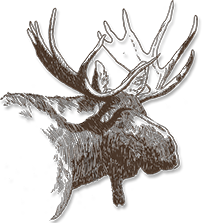
“What happened to those canoes?” If you’re looking at a bull moose with no antlers, it looks like a cow moose and this time of year, that’s what you’ll see. You can tell it’s a bull without its antlers because you will see the buttons, base of the antler (like in the above photo). If you want that bull moose shot in deep snow with its canoes, you gotta be in the right place in late fall, early winter where there is snow and the bull moose still have their antlers. They shed them during late fall/early winter to get rid of that extra weight so they don’t have to fight them and the deep snow. Moose, deer, elk have antlers and shed them (they are called sheds) and Bighorn Sheep, Mtn Goat, Bison have horns because they don’t shed them.

AK Bull Moose
captured by D5 / 180-400VR
In the late fall, the Bull Moose needs those big racks, or canoes, to better hear with. While they do use them in “battle” (the clashing a sound that’s important to the cows) their primary use is to act as a giant radar dish. If you watch the bull moose, their ears are constantly pivoting around, independently listening for the moans of cows (and predators I’m sure). They use this info to help gather up their fall harem. Once the fall rut is over with, they shed all that of weight making it much easier to travel through deep forests and river bottoms covered in snow. It is actually really pretty cool biology especially when you are fortunate enough to watch it unfold before your eyes!
Dec 20, 2019 | Wildlife Photography

Snow Geese
captured by D5 / 800mm
The sun has just hinted it’s going to appear over the horizon when the calm and quiet is shattered with a sonic boom of flapping wings! The Snow Geese who had just landed in the pond just minutes before had barely begun to mill around before lifting off again in an explosion of life. In fact, that’s what I’ve come to call it, an explosion as that best describes the chaos that seems to insue. One has to wonder how there aren’t a bunch of casualties left from midair collisions as a thousand Snow Geese dash for the heavens in less than a second! Within a heartbeat or two, the geese in all that chaos have a path up and out. They form up their flocks to fly to their next destination. The sight and sound have drawn me back to Bosque for nearly forty years, it’s a spectacular wonder that is brand new every time I witness it. It brings warmth back to the heart and soul, nature’s beautiful chaos!

Snow Geese
captured by D5 / 800mm